
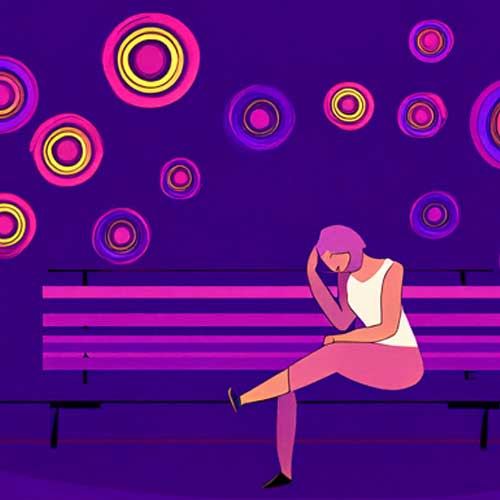
Maybe nothing is terribly wrong.
You’re getting through your days. You go to work. You answer texts. You take care of the things that need to be done. You might even laugh when something is funny.
But something feels… missing.
The things you used to look forward to don’t feel exciting anymore. Your favorite music doesn’t hit the same way. You don’t really want to go anywhere. Hobbies feel like work. You may find yourself scrolling on your phone because choosing something you actually want to do feels strangely difficult.
Someone asks what you want to do this weekend and your answer is:
“I don’t know.”
Not because you can’t decide.
Because you genuinely can’t think of anything you want.
If that sounds familiar, there is a word worth knowing: anhedonia.
What Is Anhedonia?
Anhedonia means a reduced ability to experience pleasure, interest, or enjoyment.
It can show up in obvious ways, but sometimes it is surprisingly subtle.
You may notice that:
- You no longer get excited about things you used to enjoy.
- You withdraw from friends or family.
- Food, music, hobbies, exercise, or sex feel less pleasurable.
- You stop making plans because nothing sounds appealing.
- Accomplishments don’t give you the satisfaction they once did.
- You feel emotionally flat or disconnected.
- You keep doing everything you’re “supposed” to do but feel like you’re simply going through the motions.
Sometimes people describe it as feeling numb.
Others describe it as living life behind glass: you can see everything happening, but you don’t quite feel connected to it.
“But I’m Not Sad.”
This is where people sometimes miss what is happening.
We often imagine depression as sadness—crying, staying in bed, or feeling hopeless.
But depression doesn’t always look that way.
Sometimes it looks like nothing.
No excitement.
No motivation.
No anticipation.
No real enjoyment.
A person can continue working, parenting, socializing, and handling responsibilities while privately wondering:
Why don’t I care about anything anymore?
Loss of interest or pleasure is one of the symptoms clinicians consider when evaluating depression. But depression isn’t the only possible explanation for emotional numbness or loss of enjoyment.
Sometimes Your Nervous System Is Exhausted
If you’ve lived through trauma, chronic stress, an unpredictable relationship, prolonged caregiving, loss, or years of constantly being “on,” your nervous system may have spent a tremendous amount of energy trying to protect you.
People usually know about fight or flight.
But our nervous systems have other protective responses, too.
Sometimes the response to overwhelming stress isn’t more emotion.
It’s less.
You may feel detached, shut down, exhausted, disconnected, or emotionally numb.
And that can be confusing.
You might think:
I have a good life. Why can’t I enjoy it?
What’s wrong with me?
Why don’t I want to do anything?
Why am I exhausted when I haven’t even done that much?
But a better question may be:
What has my mind and body been carrying?
The Difference Between Rest and Restoration
Here’s another frustrating experience:
You rest, but you don’t feel rested.
You spend Saturday on the couch.
You sleep late.
You watch television.
You scroll.
And Sunday arrives and somehow you still feel depleted.
That’s because stopping activity and experiencing restoration aren’t necessarily the same thing.
If your mind is still scanning for problems, replaying conversations, anticipating conflict, worrying about Monday, managing everyone else’s emotions, or criticizing you for “wasting the day,” your body may be physically still while your nervous system remains very busy.
Sometimes what we call laziness is actually depletion.
And sometimes what looks like a lack of motivation is a system that has been running on emergency power for too long.
When Productivity Becomes a Distraction
Some people respond to disconnection by stopping.
Others respond by doing more.
Work harder.
Clean something.
Start another project.
Take care of somebody.
Stay busy.
Achievement can provide a temporary sense of reward and control, which means it can take a surprisingly long time to notice that you aren’t actually enjoying your life.
You are managing it.
There is a difference.
One question worth asking yourself is:
When was the last time I did something simply because I wanted to—not because it was productive, necessary, helpful to someone else, or expected of me?
If answering that question is difficult, pay attention to that.
Trauma Can Disconnect Us From Wanting
Trauma isn’t only about remembering what happened.
It can affect our relationship with safety, connection, emotion, and even desire.
For some people, survival required becoming very good at noticing what other people needed.
What mood is Dad in?
Is Mom upset?
Is my partner angry?
What does everyone need from me?
How do I keep the peace?
What do I need to do so nothing goes wrong?
When you spend enough time monitoring the outside world, it can become surprisingly difficult to answer a much simpler question:
What do I want?
Therapy can involve more than processing painful memories.
Sometimes healing means rediscovering preference.
Curiosity.
Play.
Creativity.
Connection.
Pleasure.
And eventually, yourself.
What Can Help?
There isn’t one solution because emotional numbness can have many causes. But a few places to begin include:
Notice without judging. Instead of forcing yourself to “be grateful” or “cheer up,” become curious about what you’re experiencing.
Start small. Don’t pressure yourself to rediscover your passion for life overnight. Look for tiny moments of interest, comfort, beauty, curiosity, or connection.
Reconnect with your senses. Music, movement, art, nature, texture, temperature, and other sensory experiences can sometimes provide a different pathway into connection than thinking does.
Pay attention to your nervous system. Notice what makes your body tense, settle, withdraw, or come alive.
Talk with someone. Persistent loss of pleasure or emotional numbness deserves attention, particularly when it begins interfering with relationships, work, self-care, or everyday functioning.
And remember that persistent fatigue, loss of motivation, or emotional changes can also have physical causes. A medical provider can help rule out sleep disorders, medication effects, hormonal issues, nutritional deficiencies, and other health conditions.
You Don’t Have to Force Yourself to Feel Better
Healing isn’t pretending to be positive.
And it isn’t forcing yourself to enjoy something because you think you should.
Sometimes the first step is simply recognizing:
I haven’t felt like myself lately.
That realization matters.
At Inner Source Therapy in New Bern, NC, our clinicians work with trauma, anxiety, depression, chronic stress, grief, relationship concerns, and the experiences that can leave people feeling disconnected from themselves. Our multidisciplinary approach includes trauma-focused counseling, EMDR, expressive arts therapy, and other mind-body approaches designed to meet people where they are.
Sometimes healing isn’t about becoming a different person.
It’s about finding your way back to the parts of yourself that have gone quiet.
And they may still be there, waiting to be heard.